When you first launch your solar company, the immediate priority is survival. You need roofs to climb, panels to install, and cash flow to keep the lights on. In these early days, turning to platforms like Yelp or buying shared leads from third-party vendors makes perfect sense. It’s a quick way to get your phone ringing and start building a portfolio of local installations.
However, what works for a startup is rarely what sustains a scaling enterprise. If you are years into your business and still relying on shared leads or hoping Yelp delivers your next big contract, you are building your house on rented land. It’s a strategy that caps your growth, eats into your margins, and leaves your business vulnerable to algorithm changes you can’t control. To build a highly profitable, sustainable solar business, you have to transition from chasing shared leads to generating your own exclusive opportunities.
Here is exactly why relying on Yelp is a dangerous long-term game, and how you can pivot to a strategy that actually builds equity in your own brand.
The Shared Lead Trap: A Race to the Bottom
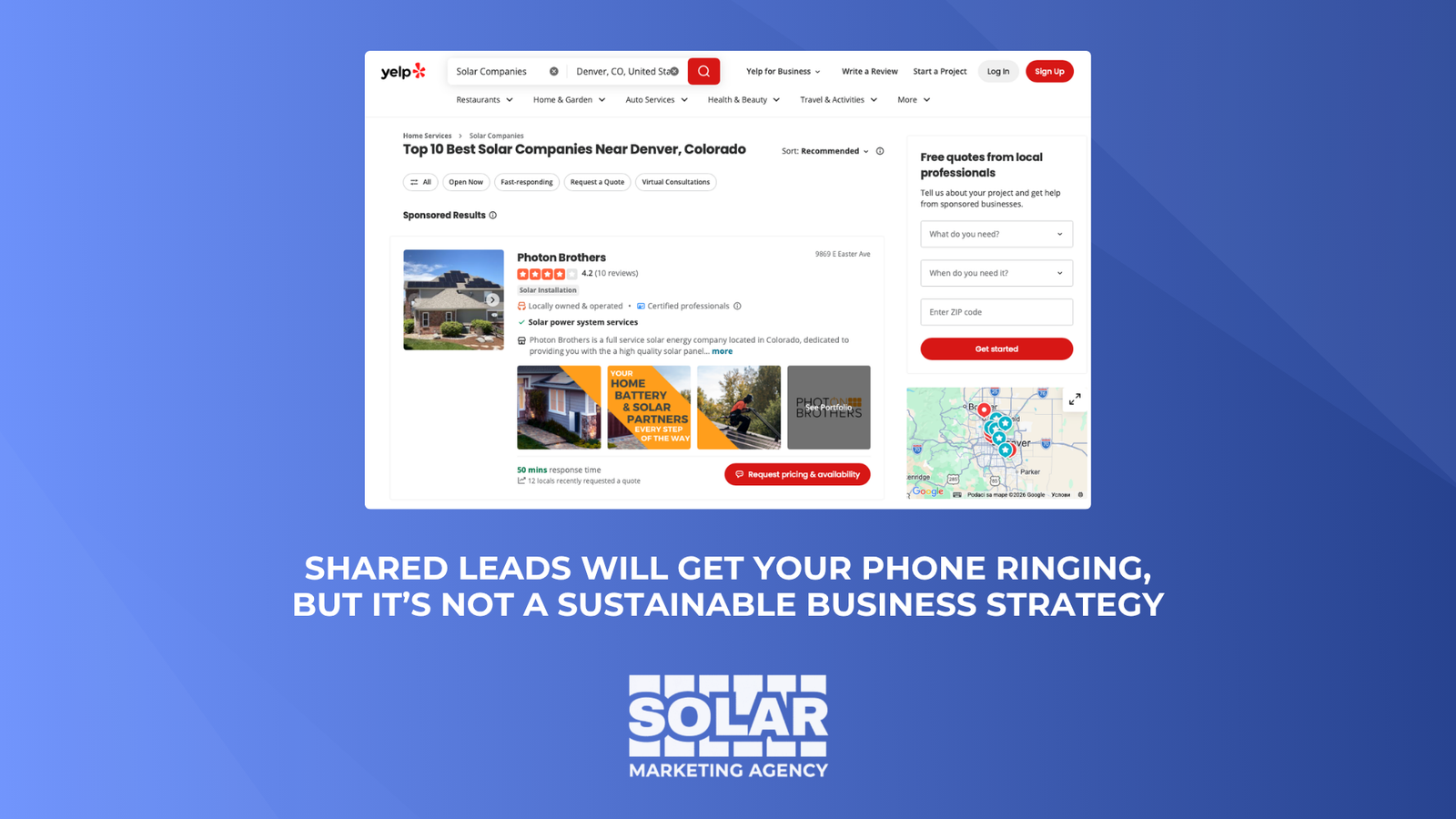
While shared lead platforms provide immediate gratification, they are structurally designed to benefit the platform, not the solar contractor. Over time, relying on them creates a toxic cycle for your sales team and your profit margins.
The First-to-Call Frenzy
When you buy a lead from a shared network, that exact same homeowner’s information is being sold to three, four, or even five of your local competitors. By the time your sales rep dials the number, the homeowner is already overwhelmed, irritated, and fielding back-to-back pitches. You are no longer selling the value of solar; you are just trying to be the loudest voice in a crowded room.
Margin Compression and the Price War
Because the homeowner views all five calling contractors as essentially the same, the conversation immediately devolves into a price war. When you lack brand differentiation, the only lever you have left to pull is your Price Per Watt (PPW). Slashing your prices to win a shared lead means you are working just as hard for a fraction of the profit.
You Are Renting, Not Owning
Platforms like Yelp own the customer relationship, not you. They dictate how your reviews are displayed, and they can (and do) filter out legitimate 5-star reviews based on their opaque algorithms. If they decide to increase their cost-per-lead or change their ranking rules tomorrow, your entire lead pipeline could dry up overnight. You are completely at their mercy.
Brand Building: Your Ultimate Competitive Advantage
Escaping the shared lead trap requires a mindset shift. You have to stop viewing your company as just another local contractor and start positioning it as an established, trusted energy authority in your community.
Trust is the Ultimate Currency
Solar is a high-ticket, permanent modification to a person’s home. Homeowners aren’t just buying panels; they are buying peace of mind. When you build a strong, independent brand, you aren’t fighting for attention. Homeowners seek you out because they recognize your logo, have seen your trucks in their neighborhood, and trust your expertise over a random name on a lead sheet.
Becoming the Local Authority
To command higher margins, you must be seen as the expert. This means producing content, sharing local case studies, and educating your community about local rebates, net metering laws, and energy efficiency. When a homeowner reads your insights before they ever speak to your sales team, the transaction shifts from a hard sell to a professional consultation.
Generating Exclusive Opportunities
The ultimate goal of brand building is exclusivity. When a homeowner searches specifically for your company name or reaches out directly through your platform, you are the only one sitting at the kitchen table. There are no other bids to beat. Exclusive leads close at a exponentially higher rate and at a much healthier profit margin.
Mastering Your Digital Storefront: Website and Organic SEO
Your website should be your hardest-working, highest-converting sales representative. If it just looks like a digital brochure, you are leaving hundreds of thousands of dollars on the table.
Transforming Your Website into a Lead Magnet
A modern solar website needs to be built for conversion. This means clear calls-to-action (CTAs), fast load speeds, and an intuitive design. Instead of just listing your services, offer tangible value. Interactive solar calculators, downloadable guides on local tax incentives, and easy-to-use consultation booking forms turn passive visitors into high-quality leads.
The Long Game of Local SEO
Search Engine Optimization (SEO) is the gift that keeps on giving. While paid ads stop the second you turn off your budget, organic SEO builds permanent digital equity. By optimizing your website for keywords like “solar installation in [Your City]” or “best solar company near me,” you ensure that your business shows up exactly when high-intent homeowners are looking for answers.
Creating Content That Answers Questions
Homeowners research extensively before buying solar. They want to know about roof integrity, battery storage, and financing options. By maintaining an active blog and resource center on your website that answers these specific questions, you capture traffic early in the buying cycle. By the time they are ready to request a quote, they already view you as the trusted guide.
Dominating Local Search with Google Business Profile
If there is one platform you absolutely must dominate as a local solar company, it is your Google Business Profile (GBP). This is the modern-day yellow pages, and it is entirely free to optimize.
Owning the “Solar Near Me” Search
When a homeowner types “solar companies near me” into Google, the first thing they see is the “Local Pack”, the map showing the top three local businesses. Ranking in this top three is critical. By fully optimizing your GBP with your exact service areas, business hours, and an accurate categorization, you dramatically increase your chances of capturing this prime real estate.
Unfiltered, Authentic Social Proof
Unlike Yelp, which frequently hides positive reviews, Google gives you a much fairer platform to showcase your stellar reputation. Make it a standard operating procedure to request a Google review after every successful installation. A profile boasting dozens of 5-star reviews from local residents is often the deciding factor for a homeowner choosing who to call.
Keeping Your Profile Active and Engaging
Your Google Business Profile isn’t a “set it and forget it” tool. You can actively post updates, share photos of recent local installations, and promote special financing offers directly to the search results page. Regularly uploading photos of your clean, professional crew working on recognizable local homes builds immediate geographical trust.
Turning on the Tap with Controlled Paid Ads
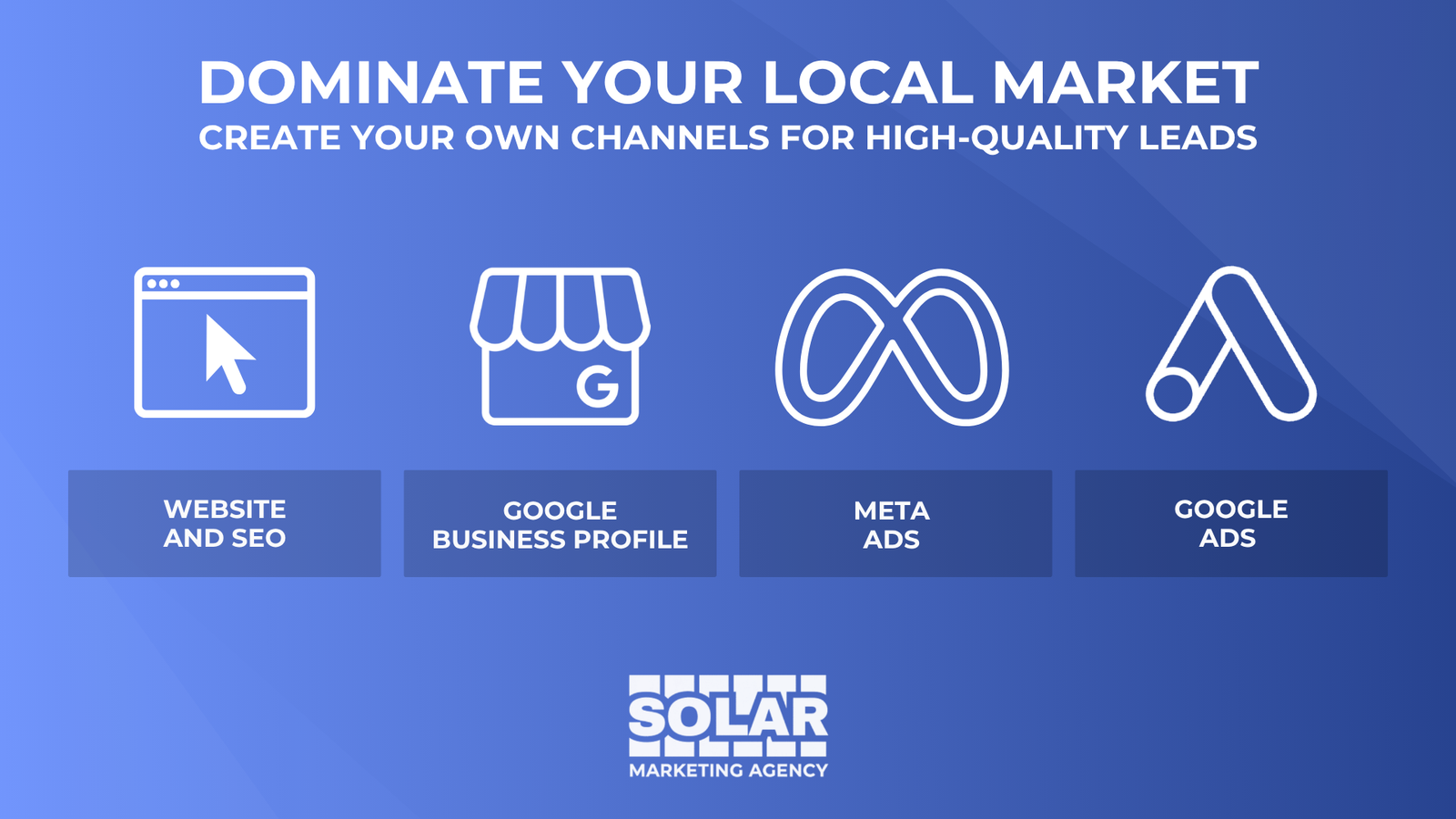
Once your organic foundation is set, it’s time to scale aggressively using paid advertising. The difference between Meta/Google ads and buying Yelp leads is that you control the targeting, the messaging, and the exclusive data.
Google Ads: Harvesting High-Intent Demand
Google Ads allow you to bypass the SEO waiting game and place your company directly at the top of the search results. Because you are targeting specific, high-intent keywords (like “solar panel installation cost”), you are reaching people who have already decided they want solar and are actively looking for a contractor. You aren’t convincing them to buy; you are just convincing them to buy from you.
Meta Ads: Creating New Demand
Facebook and Instagram (Meta) ads serve a different, but equally powerful, purpose. Homeowners might not be actively Googling for solar today, but when they scroll past a stunning video of a local installation combined with a message about erasing their $300 electric bill, you spark their interest. Meta allows you to target specific zip codes, homeowner demographics, and income levels to generate entirely new demand.
Scaling Your Winning Campaigns
The beauty of managing your own ad campaigns is predictability. Once you find a formula that works—where your cost per acquisition is lower than your profit margin, you can confidently scale your budget. You are no longer waiting and hoping for a platform to send you a lead; you possess a predictable machine where putting $1 in yields $5 back in closed jobs.
Conclusion
It is entirely okay to rely on shared leads to get your company off the ground. But to build a legacy, you must take control of your own pipeline. Stop feeding the platforms that pit you against your competitors, and start investing in your own brand, your own website, and your own ad strategies.