You’ve just cleared the final inspection. The interconnection agreement is signed, the system is energized, and the homeowner is watching their meter spin backward for the first time. They’re thrilled. You shake hands, jump in the truck, and head to the next job site.
In your mind, that’s a successful project. In Google’s mind? It didn’t happen.
If that happy customer doesn’t translate their experience into a five-star digital footprint, you are leaving your most valuable marketing asset on the table. For solar installers, online reviews aren’t just “nice to have”-they are the lifeblood of your lead generation and the primary way Google decides if you deserve to be on Page 1.
Here is why your review strategy (or lack thereof) is making or breaking your solar business.
The “Fly-By-Night” Stigma and the Trust Gap
Solar is a high-ticket, high-consideration purchase. Unlike hiring a plumber for a $200 leak, a homeowner is committing to a 25-year relationship and a five-figure investment.
Unfortunately, our industry has been plagued by “trunk slammers” and door-knocking companies that disappear six months after the panels are bolted down. Homeowners are naturally skeptical. They aren’t just looking for the best price; they are looking for proof of longevity.
A steady stream of recent reviews acts as your “digital insurance policy.” It tells a prospect, “We were here last month, last year, and three years ago, and we actually answer the phone when there’s an inverter issue.” Without reviews, you aren’t just a local expert, you’re a risk.
Google Doesn’t Just Read Your Site; It Reads Your Reputation
We often talk about SEO in terms of keywords and backlinks, but for local solar companies, Review Signal is a massive ranking factor for the Google Map Pack.
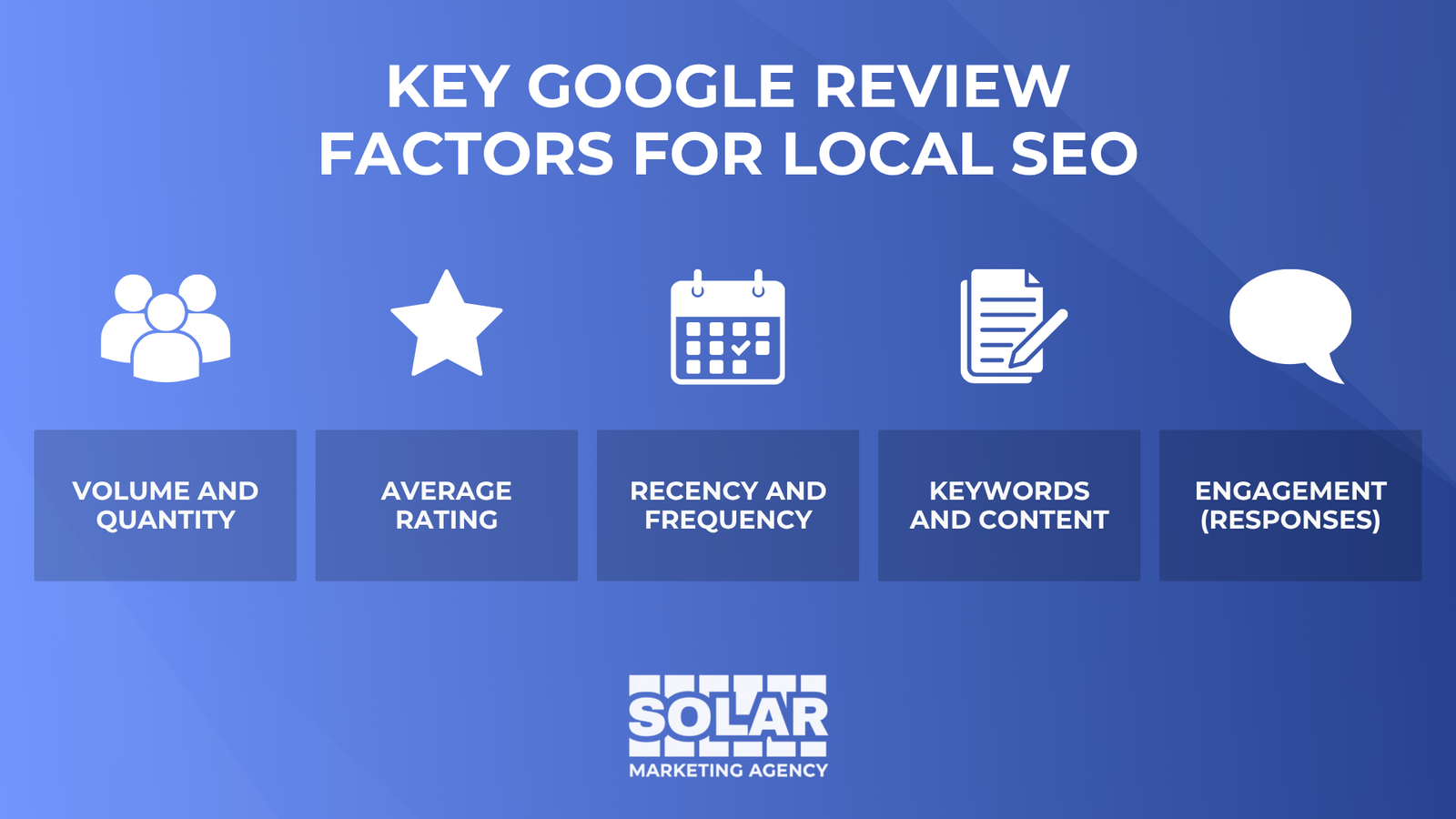
Google looks at these specific review metrics:
- Volume and Quantity: A higher total number of reviews generally improves local search ranking and visibility.
- Average Rating: While 5 stars are good, ratings between 4.2 and 4.5 are often seen as most trustworthy, so don’t worry if you get a bad review here and there.
- Recency and Frequency: Recent reviews are more powerful than old ones, showing that your business is actively engaged.
- Keywords and Content: Keywords within review text help Google understand your business services, improving ranking for specific search queries.
- Engagement (Responses): Responding to both positive and negative reviews increases trustworthiness and engagement, signaling an active business.
When a customer leaves a detailed review mentioning your “professional install crew in San Diego,” Google scans those keywords. It confirms your location and your service, boosting your relevance for local searches.
Outshining the Competition Without Raising Your Ad Budget
Even if your website’s technical SEO isn’t perfect, a high-quality review profile can jump you to the front of the line. Google often uses what are called “Review Snippets”, those bolded lines of text that appear directly under your business name in search results. If a homeowner searches for “solar with battery backup near me,” and a handful of your customers have mentioned their “battery backup” or “Powerwall installation” in their 5-star reviews, Google is significantly more likely to highlight your business and bold those specific keywords.
This effectively allows your customers to do your keyword optimization for you. By talking about their specific experience with your crews, the equipment you used, and the city they live in, they are creating a massive increase in your organic Click-Through Rate (CTR) that no amount of fancy web design can replicate.
The “Social Proof” Conversion Engine
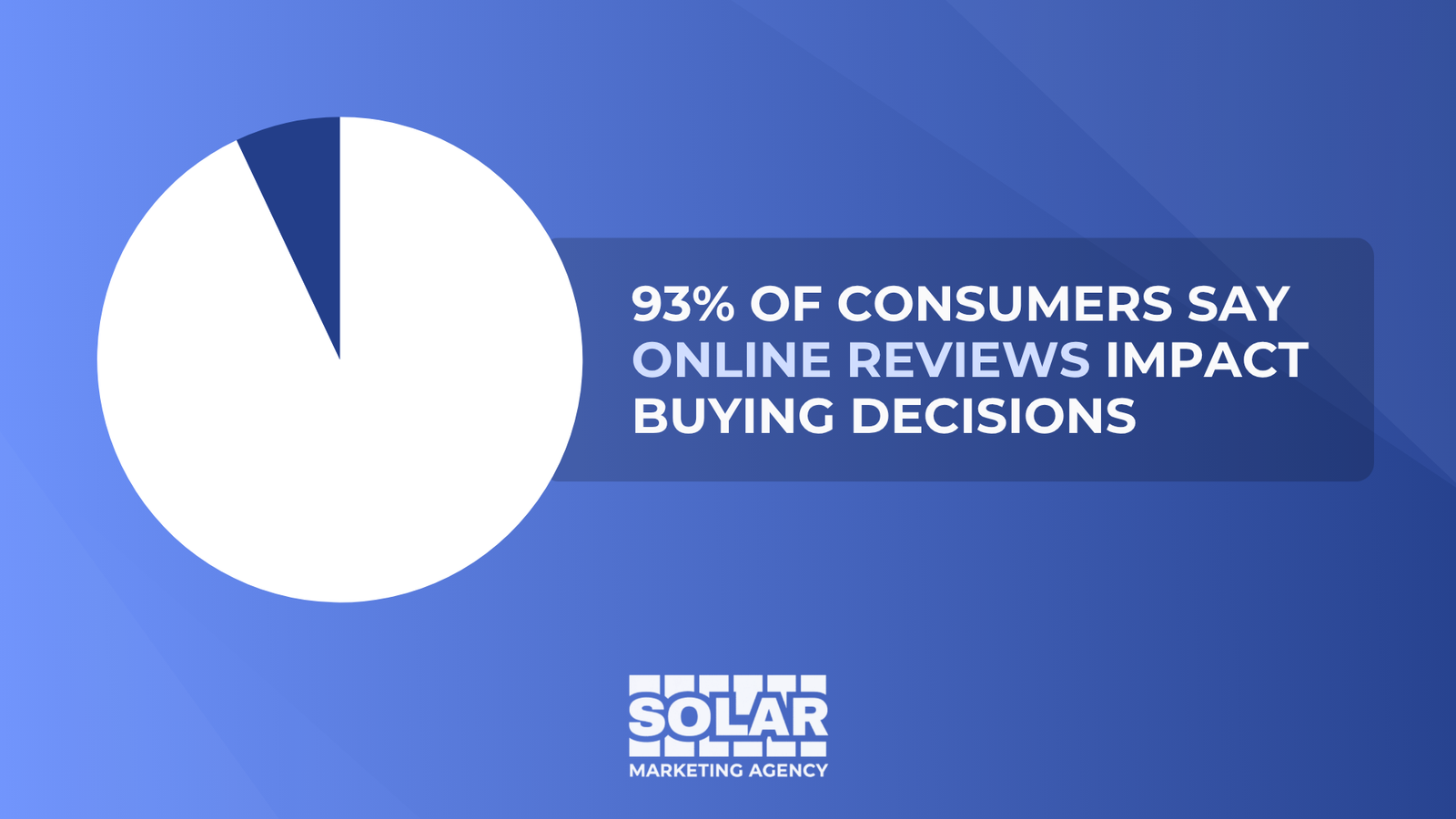
You can spend thousands on a slick website and professional drone photography, but 93% of consumers say online reviews impact their purchasing decisions.
Your marketing copy says you’re the best. A review says you actually did the job. In the solar sales cycle, reviews are often the “final nudge.” A prospect might see your Facebook ad, visit your site, and then go straight to Google Maps to see what neighbors are saying. If they see a 4.8-star rating with detailed stories of great communication, your sales team’s job just got 50% easier.
Negative Reviews Are An Opportunity (Seriously)
Many solar owners are terrified of a 1-star review, or a customer frustrated by a utility company delay out of your control. Here’s a secret: A 5.0 rating is actually less trustworthy than a 4.8. Consumers know that perfection is impossible. They look at how you handle the “bad” situations.
Ignore the complaint? You look guilty. But when you respond professionally, offer to make it right, and explain the situation, you look like a legitimate business owner who stands by their work. Google rewards engagement. Responding to every review, good and bad, signals to the algorithm that you are an active, trustworthy entity.
The Fix: Stop Wishing, Start Systemizing
You cannot leave your reputation to chance. If you wait for customers to “remember” to review you, you’ll only get the ones who are angry. Happy customers need to be prompted.
- The “Golden Moment”: The best time to ask for a review isn’t at the contract signing; it’s the day the system is turned on (PTO) or after they see their first $0 utility bill.
- Automate the Ask: Use your CRM or a dedicated reputation management tool to send a text and email link the moment a project status hits “Completed.”
- Remove the Friction: Don’t just say “Leave us a review.” Send them a direct link that opens the Google review box on their phone.
Conclusion
In the solar industry, your reputation is your revenue. You can have the best panels and the fastest install times in the state, but if your Google Business Profile is a ghost town, your phone will stay silent.
Ranking on Google is about more than just code, it’s about proving to the world (and the algorithm) that you are the trusted local authority.