If you run a solar company, you already know how fiercely competitive the industry has become. Every day, homeowners are searching for ways to lower their utility bills, achieve energy independence, and take advantage of tax incentives. But if your website isn’t showing up on the first page of Google, those potential customers are going straight to your competitors.
Chances are, you’ve experimented with pay-per-click (PPC) ads on Google or Facebook. While paid ads can generate immediate leads, they operate like a treadmill: the moment you stop paying, the leads stop coming in. In an industry where customer acquisition costs are notoriously high, relying solely on paid traffic will eventually squeeze your profit margins.
This is where Search Engine Optimization (SEO) comes into play. SEO is the process of optimizing your website so that it naturally ranks higher in search engine results. It is the digital equivalent of owning real estate rather than renting it. In this guide, we will break down exactly how you can get your solar company found online without constantly pulling out your credit card, why you need to adopt a long-term mindset, and the fundamental steps to build a sustainable lead generation machine.
1. The Marathon, Not the Sprint: Understanding the SEO Timeline
Before diving into the tactics, it is crucial to set the right expectations. As a business owner, you are used to solving problems quickly. With paid ads, you can launch a campaign on Monday and have the phone ringing by Tuesday. SEO does not work like that.
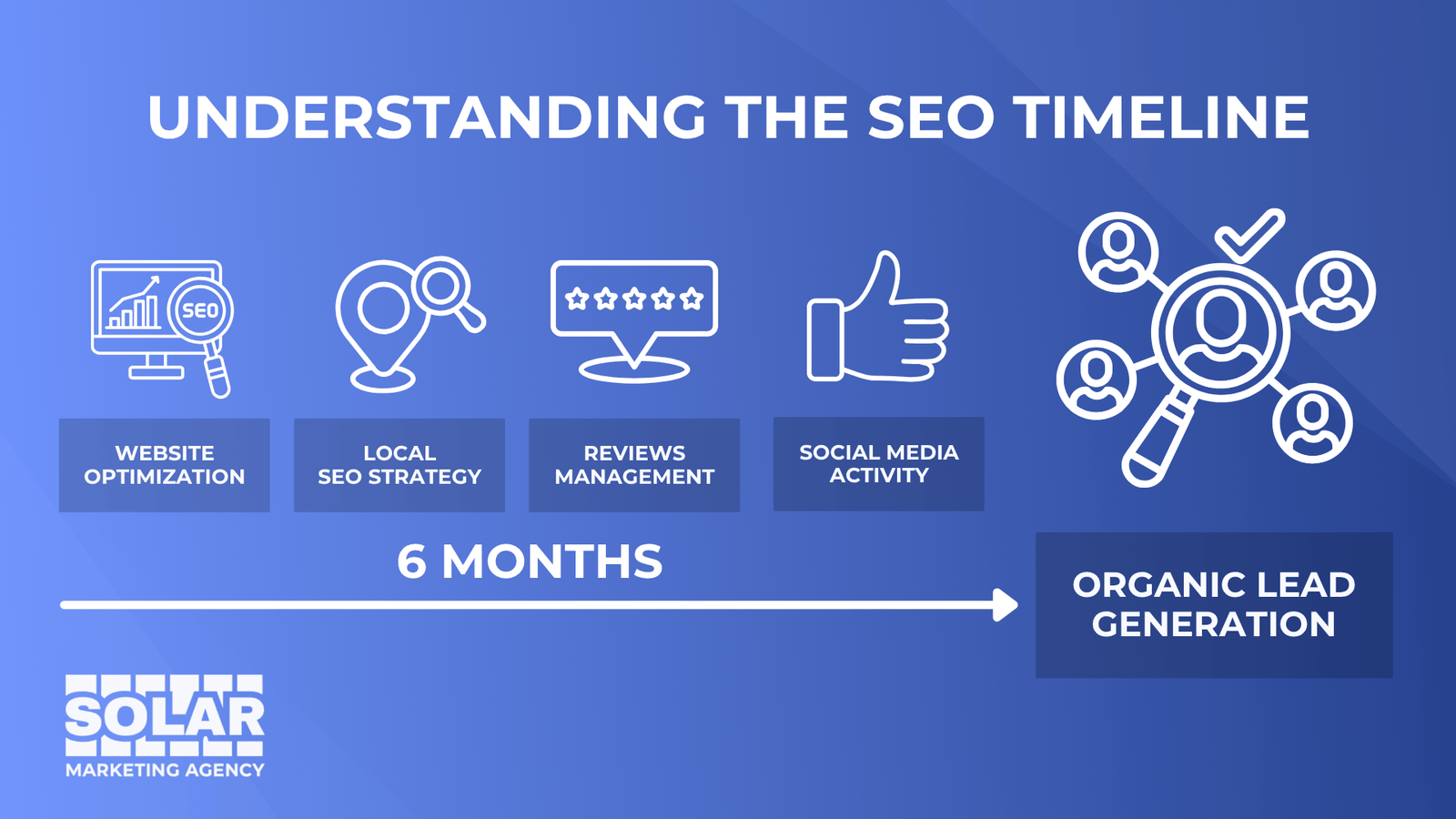
SEO is a marathon, not a sprint. When you optimize your site, you are essentially trying to prove to Google that your solar company is the most relevant, authoritative, and trustworthy answer to a homeowner’s query. Building that trust takes time. Realistically, it takes anywhere from three to six months to start seeing significant upward movement in your rankings, and sometimes up to a year to dominate highly competitive local markets.
However, the delayed gratification is exactly what makes SEO so powerful. While your competitors are burning through their marketing budgets month after month, the SEO work you do today will continue to generate free, organic leads for years to come. Once you establish a strong ranking, you build a steady, reliable pipeline of high-intent customers that drastically lowers your overall cost per acquisition. SEO is not a quick fix; it is the foundation of long-term business growth.
2. Keyword Research: Knowing Exactly What Homeowners Are Searching
The foundation of any successful SEO strategy is keyword research. You cannot optimize your website if you do not know the actual words and phrases your potential customers are typing into Google.
Many solar installers make the mistake of targeting broad, highly competitive terms like “solar panels.” Trying to rank for a generic term against national giants is an uphill battle. Instead, you need to focus on “long-tail keywords”, longer, more specific phrases that signal high buying intent and local relevance.
Think about the specific questions homeowners in your area are asking. Your target keywords should look more like:
- “Solar panel installation cost in [Your City]”
- “Best solar companies near me”
- “How does solar net metering work in [Your State]”
- “Are solar panels worth it in [Your County]”
By optimizing your website for these specific, localized queries, you attract traffic that is highly qualified. These aren’t just people casually browsing the concept of renewable energy; these are homeowners actively looking to hire a contractor in your service area.
3. On-Page SEO: Optimizing Your Digital Storefront
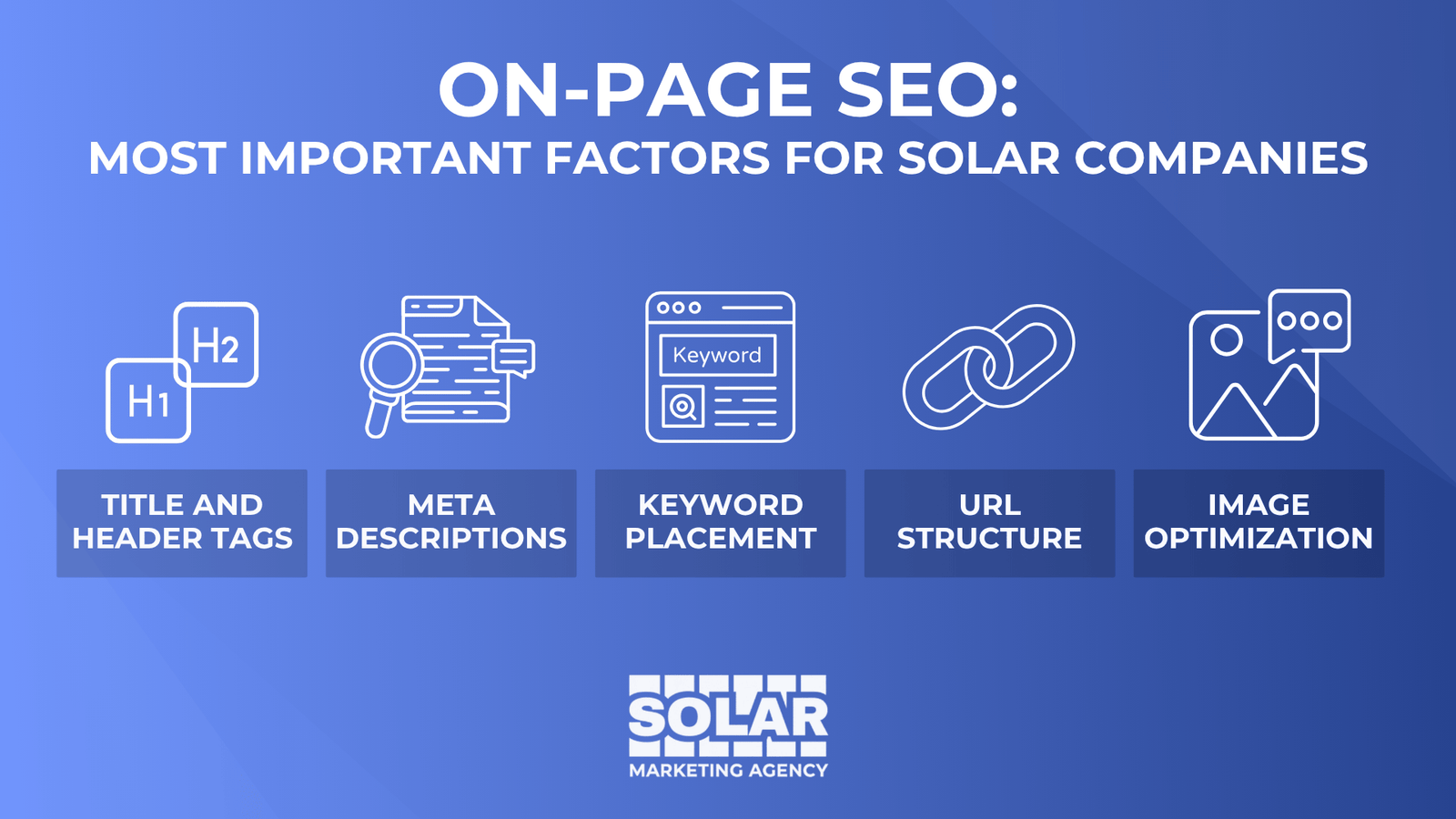
Once you know the keywords you want to target, you need to seamlessly integrate them into your website. This practice is known as on-page SEO. It involves tweaking the elements on your website so that search engines can easily read, understand, and categorize your content.
Here are the critical on-page elements you need to get right:
- Title Tags: This is the clickable headline that appears on the Google search results page. It should accurately describe the page’s content and include your primary keyword and your city. For example: Top Solar Panel Installers in [City] | Your Company Name.
- Meta Descriptions: This is the short snippet of text below the title tag. While it doesn’t directly impact rankings, a compelling meta description increases the chances that a user will click on your link instead of a competitor’s.
- Header Tags (H1, H2, H3): Break your text up using headers. Your main title should be an H1 tag containing your primary keyword. Use H2 and H3 tags to organize subtopics, making it easy for both Google and human readers to scan your page.
- URL Structure: Keep your URLs clean and descriptive. Instead of yourwebsite.com/page123, use yourwebsite.com/solar-installation-[city].
- Keyword Placement: Once you have your primary keyword, make sure it appears naturally within the first 100 words of your page. Sprinkle it, along with related variations, throughout the rest of the text. Avoid “keyword stuffing”, Google penalizes content that reads like it was written for a robot rather than a homeowner.
- Image Optimization: Search engines cannot physically “see” your images, so you have to tell them what the picture is about. Use descriptive file names before uploading (like solar-panel-installation-texas.jpg instead of IMG_1234.jpg) and write clear “alt text” for every image that includes your keywords where relevant.
4. Local SEO: Dominating Your Immediate Service Area
For a solar company, national traffic is essentially useless. If you operate in Texas, a website visitor from New York does nothing for your bottom line. Therefore, Local SEO is arguably the most critical component of your organic growth strategy.
The crown jewel of Local SEO is the “Google Map Pack”, the section at the top of local search results that displays a map and three local businesses. Getting into the top three spots can transform your business overnight.
To dominate local search, you must claim and fully optimize your Google Business Profile (GBP). Ensure that your NAP (Name, Address, Phone Number) is 100% accurate and matches exactly what is listed on your website. Fill out every category, upload high-quality photos of your team and recent installations, and regularly post updates.
Furthermore, you need to build local citations. This means getting your business listed in local directories, Chamber of Commerce websites, and industry-specific platforms like the Better Business Bureau. Consistency across all these platforms signals to Google that you are a legitimate, established local business.
5. The Power of Online Reviews: Building Trust and Authority
In the solar industry, trust is everything. Installing solar panels is a massive financial decision and a major modification to a person’s home. Homeowners will do their research before reaching out. Reviews are not just important for convincing homeowners to hire you; they are heavily factored into Google’s local ranking algorithm.
You need to establish a systematic process for generating reviews. Every time you complete an installation and the system is turned on, ask the satisfied homeowner for a review. Make it as easy as possible by sending them a direct link to your Google Business Profile via text or email.
Crucially, you must respond to every single review, both positive and negative. Thank happy customers for their business, and address any negative feedback professionally and promptly. Google sees an active, engaged business owner as a positive ranking signal, and potential customers will appreciate your transparency and dedication to customer service.
6. Technical SEO: Ensuring a Flawless User Experience
You can have the best content in the world, but if your website is broken, slow, or hard to navigate, Google will not rank it. Technical SEO refers to the behind-the-scenes framework of your website.
First and foremost, your website must be mobile-friendly. Over half of all local searches are performed on smartphones. If a homeowner lands on your site and has to pinch and zoom to read your text, they will leave immediately (increasing your “bounce rate,” which actively harms your SEO).
Second, focus on page speed. Modern consumers have zero patience for slow-loading websites. Compress your images, minify your code, and invest in high-quality hosting.
Finally, ensure your site is secure. Your website URL should begin with “HTTPS” rather than “HTTP,” indicating that you have an active SSL certificate. Google explicitly penalizes sites that are not secure, as it wants to protect its users’ data.
Conclusion: Start Building Your Organic Engine Today
Relying entirely on paid advertising is a risky, expensive way to run a solar company. While ads have their place in a balanced marketing strategy, true, scalable, long-term growth comes from Search Engine Optimization.
Yes, SEO requires patience. It takes time to research keywords, optimize your site, build local authority, and publish great content. You will not see results overnight. But if you commit to the process, SEO transforms your website from a digital brochure into a 24/7, automated lead generation machine. By putting in the work today to dominate your local search results, you ensure that your business will be thriving, profitable, and booking high-quality jobs for years to come.