As a solar company owner, you know exactly how fiercely competitive the renewable energy industry has become. Buying shared leads from third-party vendors usually results in a frustrating race to the bottom, forcing you to compete on price against multiple installers calling the exact same homeowner.
To build a sustainable and highly profitable solar business, you need to generate your own exclusive, high-intent leads. In today’s digital landscape, the most effective way to capture homeowners actively looking to go solar is by dominating your local area, specifically by ranking in the Google Map Pack.
When a homeowner searches for phrases like “solar installers near me” or “best solar company in [City],” they want a trusted local expert. They are looking for someone who understands their specific utility company, local net metering policies, and state tax incentives.
The Google Map Pack, that prominent block of three local business listings at the very top of Google’s search results, is absolute prime real estate. Earning a spot in this “Local 3-Pack” is the holy grail of local SEO. Here is exactly why local visibility matters and your complete blueprint to climb the ranks.
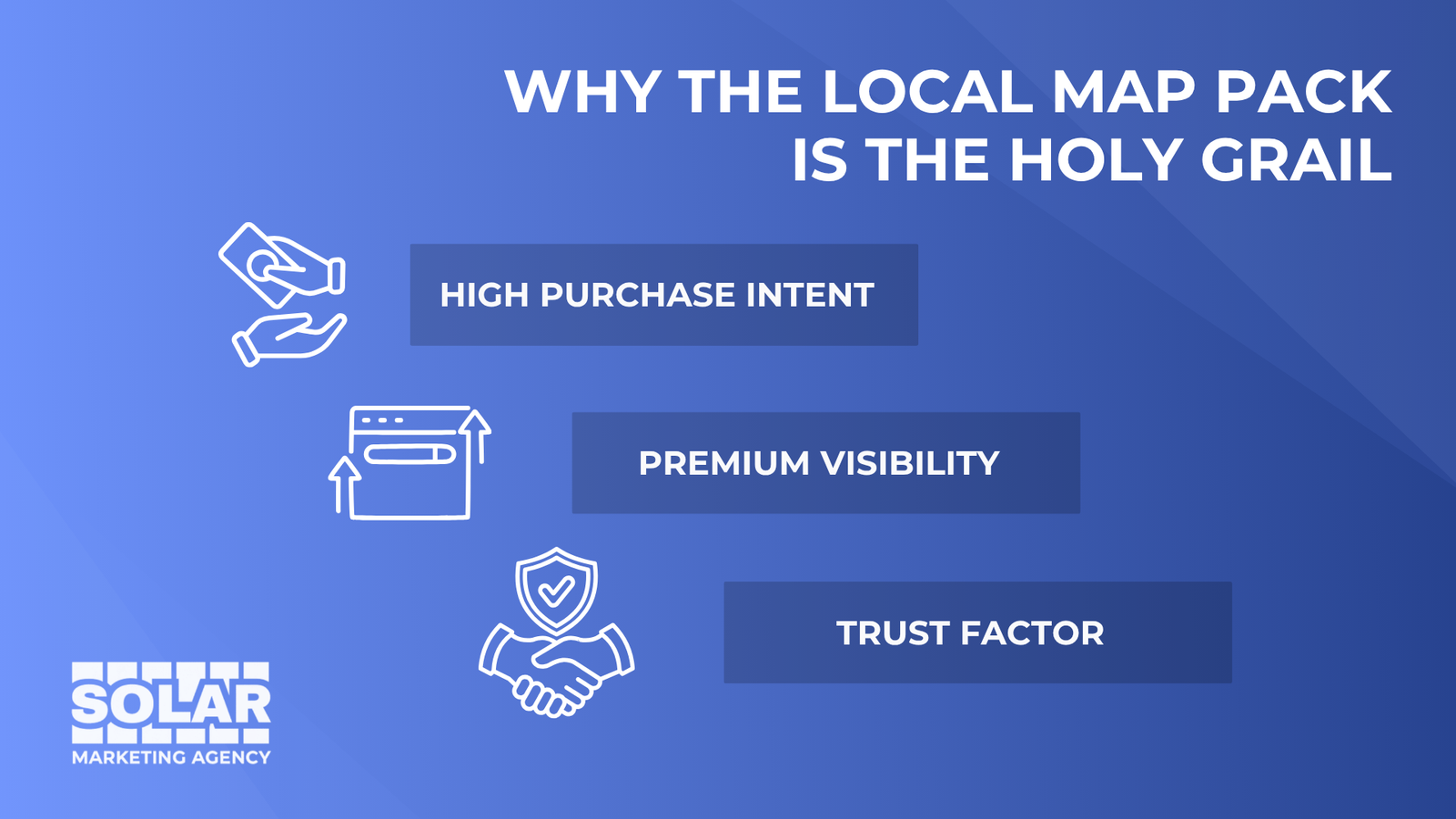
Why the Local Map Pack is the Holy Grail
1. High Purchase Intent People searching for local solar installers are typically at the bottom of the sales funnel. They have already done their initial research and understand the financial and environmental benefits of going solar. Now, they are actively seeking a contractor for a customized quote. Capturing this search traffic means you are capturing leads that are ready to convert into paying customers.
2. Premium Visibility The Map Pack appears completely above standard organic search results. Even if a massive national brand holds the number one organic spot for a keyword, a well-optimized local business can leapfrog them entirely by appearing in the Map Pack. This provides regional installers an incredible opportunity to outshine massive corporations in their specific service areas.
3. The Trust Factor Going solar is a major financial investment and a significant home improvement project. Homeowners need to feel completely confident in the contractor they choose. When Google features your business in the Map Pack, complete with a solid star rating and local address, it acts as an implicit endorsement. It signals to homeowners that you are a legitimate, established business embedded right in their own community.
Step 1: Optimize Your Google Business Profile
Your Google Business Profile is the absolute foundation of your entire local SEO strategy. You cannot rank in the Map Pack without a verified profile. If you have not claimed yours yet, make that your top priority today. If you have claimed it, you must optimize every single field available to you.
- Exact Business Name: Always use your actual, legal business name. Do not attempt to stuff keywords into your title. For example, avoid naming your profile “John’s Solar Best Installers in Texas.” Google actively penalizes keyword stuffing, and engaging in this practice can lead to a complete profile suspension.
- Categories: Your chosen categories serve as a major ranking factor. Your primary category should always be “Solar Energy Company” or “Solar Energy Equipment Supplier.” If you also offer specialized roofing or electrical services, be sure to add those as secondary categories to capture related searches.
- Business Description: Use your 750 characters to naturally weave in your core services like residential installations, commercial projects, and battery backup systems, along with your primary service cities.
- Service Areas: Keep your service areas highly accurate and realistic to where you actually dispatch your sales representatives and installation crews. Casting an overly wide net can actually dilute your local relevance.
- Photos and Videos: Solar is a highly visual product. Upload high-resolution photos of completed arrays, your brightly branded trucks, and your crew working safely on a roof. Profiles with a high volume of quality photos consistently receive significantly more engagement and direct calls than those with outdated or missing images.
Step 2: Ensure NAP Consistency and Build Local Citations
Google’s algorithm relies heavily on trust. To verify that your business is legitimate and operating where you claim, Google looks for consistent NAP information across the internet. NAP stands for Name, Address, and Phone Number.
A “citation” is simply a mention of your NAP on another website or directory. To boost your local rankings, you must build citations on high-authority platforms relevant to your industry.
- Core Directories: Start by listing your business accurately on major platforms like Yelp, Apple Maps, Bing Places, the Better Business Bureau, and Angi. Ensure your address format is perfectly matched across every single site.
- Industry Directories: Look for solar-specific directories. Getting listed on sites like SolarReviews or the directory of your local green energy association provides excellent industry relevance.
- Chambers of Commerce: Joining your local Chamber of Commerce usually provides a powerful, highly localized backlink and citation from a trusted local domain.
If Google sees your exact NAP listed consistently across 50 reputable websites, it validates your existence and dramatically boosts your local ranking power.
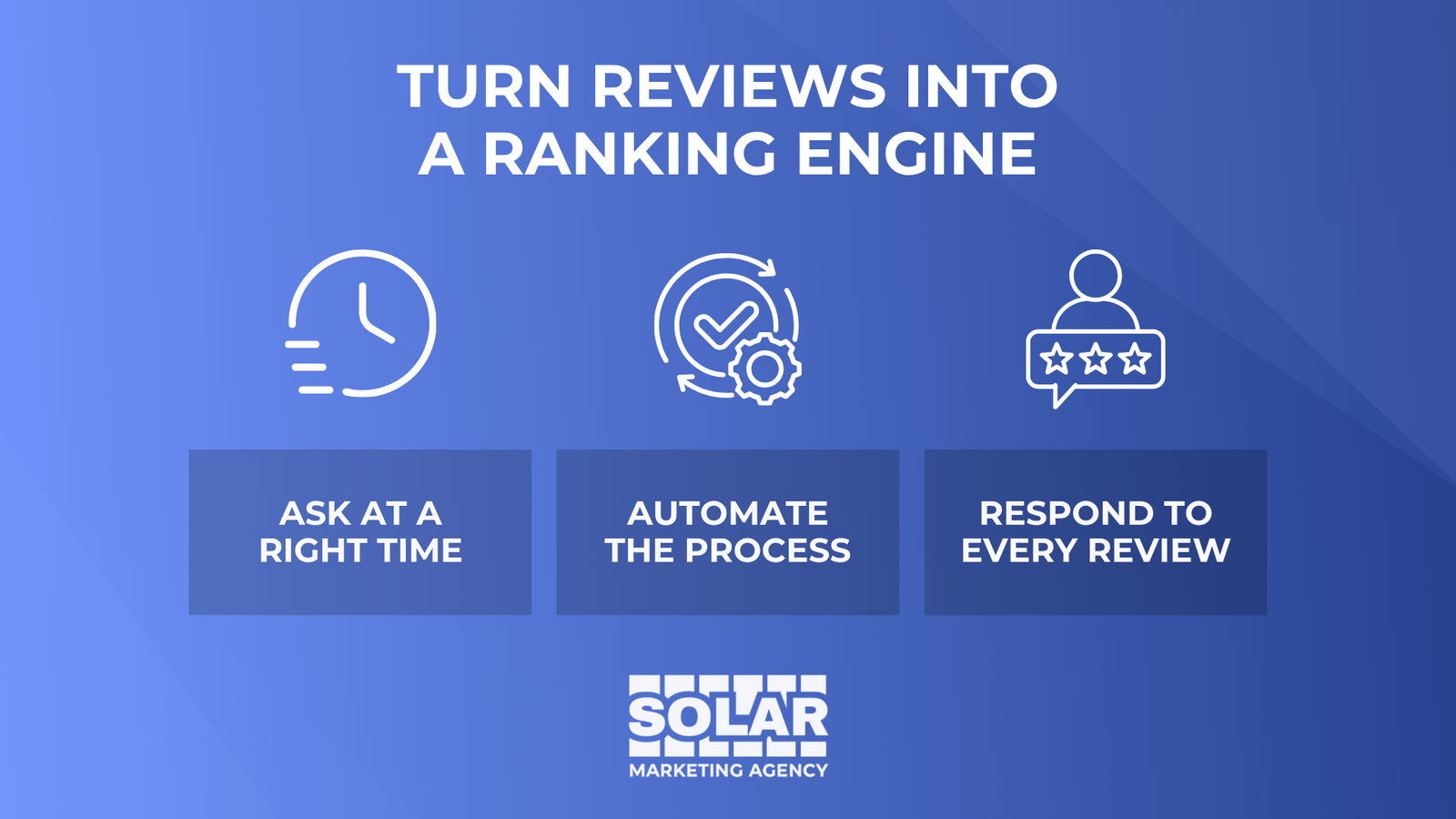
Step 3: Turn Reviews Into a Ranking Engine
Reviews heavily influence a homeowner’s final decision and serve as a massive ranking factor for the Map Pack. A profile boasting 150 five-star reviews will almost always outrank a profile with only 12 reviews, even if the business with fewer reviews is physically closer to the searcher.
- Ask at the Right Time: The best time to ask for a review is immediately after Permission to Operate is granted. The homeowner is excited to finally turn their system on and watch their meter spin backward, so capitalize on that peak excitement.
- Automate the Process: Do not rely purely on your sales representatives to remember to ask for reviews. Use automated text messages or emails triggered by your customer relationship management software. When a project is marked as completed, send a polite message providing a direct link to your Google review page.
- Respond to Every Review: You must dedicate time to respond to every single review you receive. For positive ones, thank the customer by their first name and mention the city where the work took place. For negative reviews, respond professionally, offer a constructive solution, and attempt to take the conversation offline to resolve the issue privately.
Step 4: Localize Your Website’s On-Page SEO
Your Google Business Profile does not operate in a vacuum. Its ranking power is closely tied to the authority and relevance of your website. Your site must send strong local signals to rank high in the Map Pack.
- Dedicated Location Pages: If you serve multiple counties or major cities, create a dedicated service page for each major market. Discuss specific local utility companies, regional net metering rules, and local municipal rebates on these pages to prove your local expertise.
- Embed a Google Map: Make sure to embed the actual Google Map of your listing directly onto your primary contact page and all of your dedicated location pages.
- Optimize Meta Tags: Ensure your primary target keywords and your location are prominently featured in your title tags. Instead of a generic title, use something highly descriptive like “XYZ Solar | Premier Solar Installers in Austin.”
- Schema Markup: Utilize Local Business Schema markup in your website’s background code. This feeds search engines your exact business details in a highly structured language they can easily digest and verify.
Step 5: Leverage GBP Posts and Q&A
Google wants to see that your business is active, engaged, and currently operating. Use the built-in tools on your Google Business Profile to show this consistent engagement.
- Google Posts: Treat this feature like a localized social media feed. Publish updates, educational content, or special offers weekly. Post about a recently completed installation in a specific neighborhood, explain recent federal tax credit changes, or announce new financing options. This keeps your profile fresh and shows Google you are active.
- The Q&A Section: Anyone can ask or answer a question on your profile. Do not let random internet users provide incorrect answers about your business. Proactively populate this section yourself. Have someone on your team ask common questions about battery backups or warranty terms, and answer them thoroughly from the owner’s account so homeowners get accurate information immediately.
Stop Chasing Bad Leads
Ranking in the Google Map Pack is certainly not an overnight process, but it remains one of the absolute highest-ROI marketing investments a solar company can make today. By meticulously optimizing your profile, building authoritative citations, generating a steady stream of reviews, and fine-tuning your website, you can dominate your neighborhood and establish a predictable pipeline of exclusive solar leads.